Showing posts with label CCCP. Show all posts
Monday, April 26, 2010

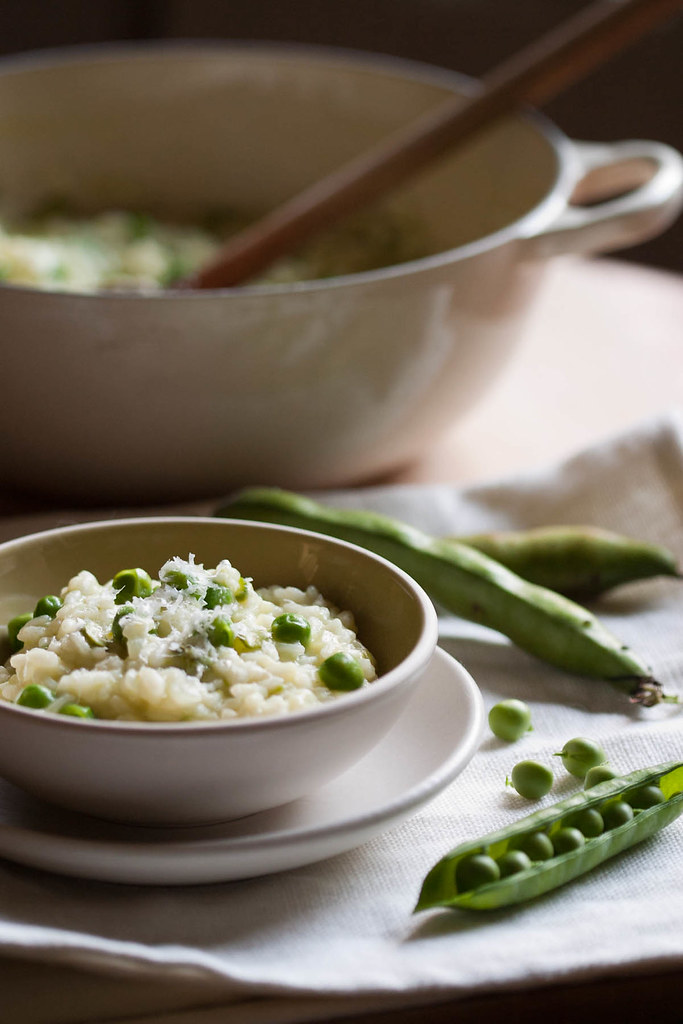
Green risotto for a green day

Serving

Last week I posted various links with information on how you can get more green in your life. Today I'm going to post about getting more green in your diet. I don't mean the sustainability kind of green (though of course it can be that, too); I mean the crisp, lively, juicy spring green that's so welcome when you're starting to have had your fill of root vegetables.
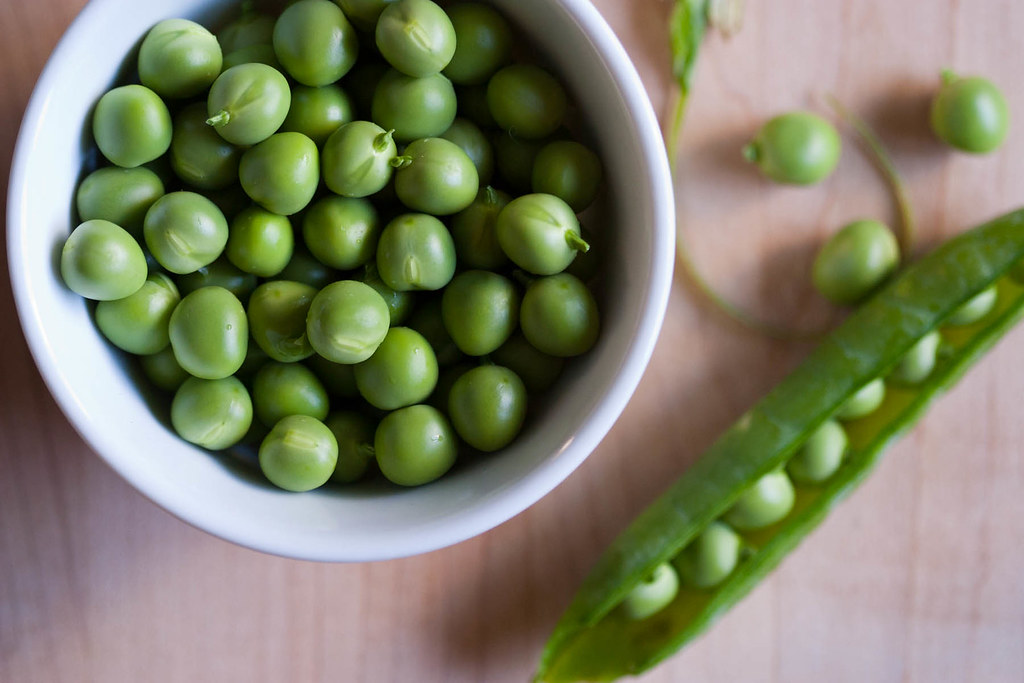
Shelling peas

The look of my local farmer's market is changing rapidly these days, exchanging the warm yellows and oranges of winter citrus for the vibrant greens of spring vegetables. Gone are the blood oranges and cara caras; in their place are tables overflowing with fresh peas. Last weekend we even got our first fava beans, and I was ready with a recipe. A green recipe!
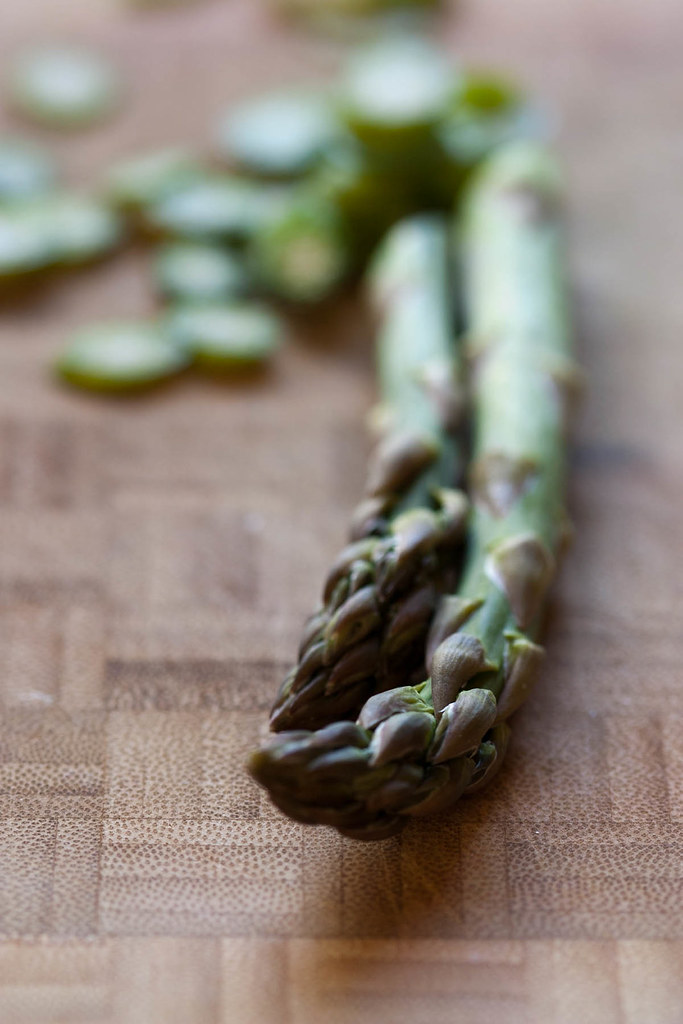
Slicing asparagus

This risotto has been on my to-do list ever since I came across it in Alice Waters' Chez Panisse Vegetables last summer (after the favas had disappeared from the markets, naturally) because it combines one of my favorite things about spring (fresh peas) with one of my favorite things in general (risotto). But it's not just peas, and this is where we really get our green on. This risotto takes the best of the spring green vegetables: peas, fava beans, and asparagus.
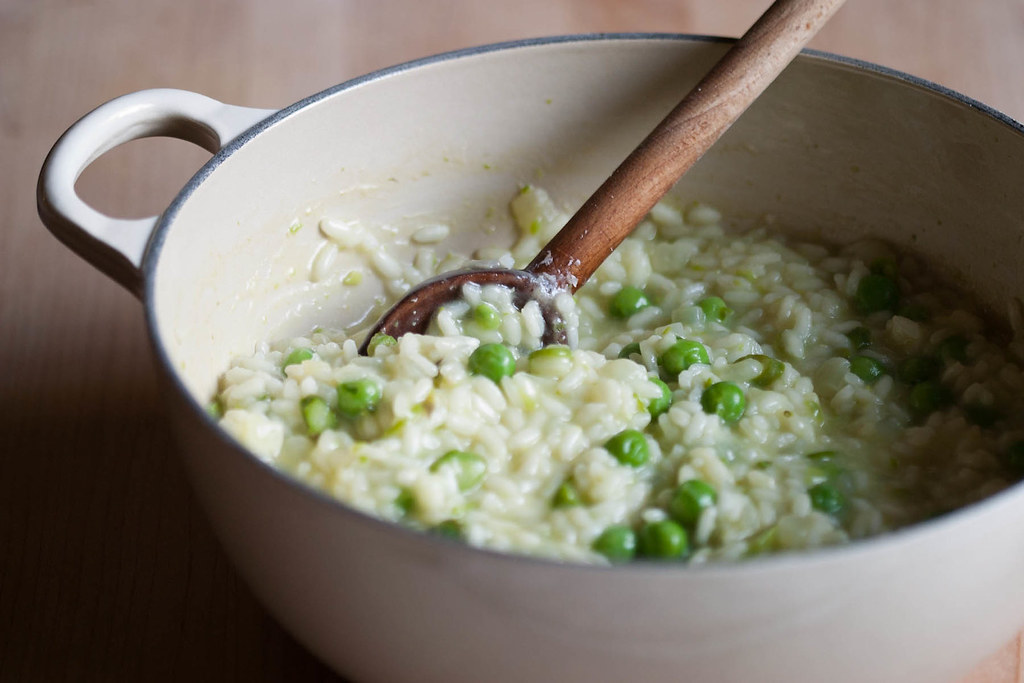
Risotto pot

That might sound like a lot--indeed, done poorly, I can imagine the result feeling clumsy--but Waters incorporates the vegetables in such a way that none of them steps on another's toes. And although in my mind risotto falls squarely in the warming, cozy "comfort food" category, this risotto manages to be at once comforting and refreshing. I don't know how better to describe it than to say that it tastes of spring. And if that doesn't chase away the winter doldrums, I don't know what will.
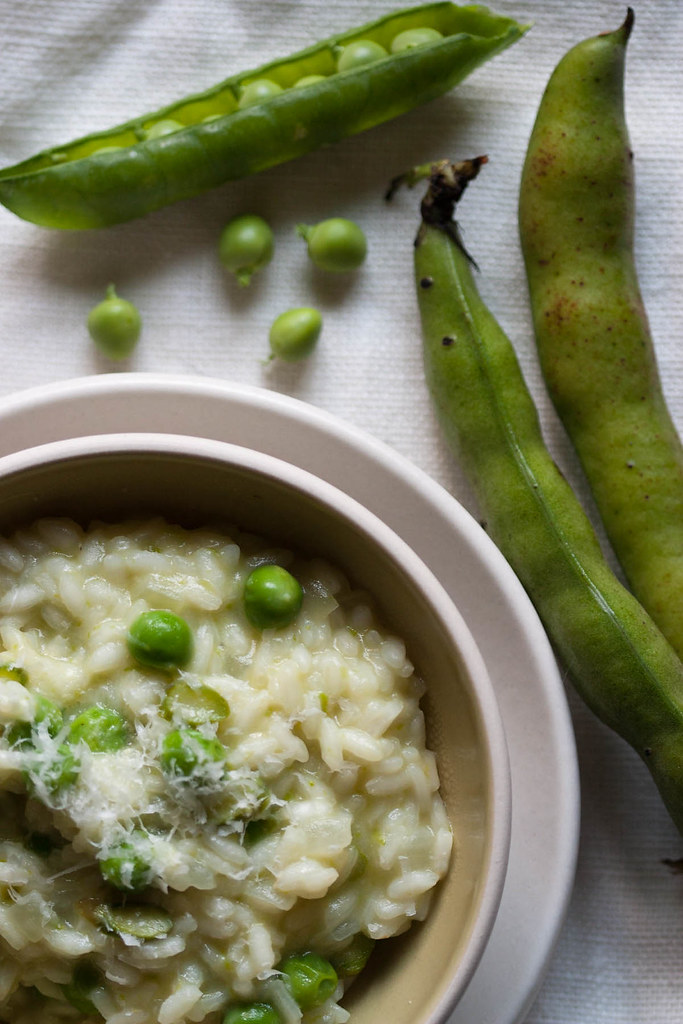
Spring vegetables and risotto

Green Risotto with Fava Puree, Peas, and Asparagus

Adapted from Chez Panisse Vegetables
Serves 6, or 4 generously

Ingredients

  • 1/2 pound young fava beans (weighed in their pods)
  • Olive oil
  • Coarse salt and freshly ground pepper to taste
  • 3/4 pound fresh green peas (again, weighed in their pods)
  • 4 spears of asparagus
  • 1 medium onion
  • 7 to 8 cups good stock (vegetable or chicken, as you like)
  • 4 1/2 tablespoons unsalted butter
  • 2 cups arborio rice
  • 1/3 cup dry white wine
  • 1/4 cup grated Parmesan cheese, plus extra for serving

Directions

  1. Bring a large pot of water to boil. While you're waiting for it to boil, prepare an ice bath, and shell the favas. Discard--or compost!--the pods.
  2. When the water's boiling, add the favas and let them cook for one minute before draining them and shocking them in the ice bath to stop the cooking.
  3. Drain them again, then peel them by piercing the outer skin with your thumbnail at one end, and squeezing the bean out with the thumb and forefinger of your other hand.
  4. Place the peeled beans in a small pot with a glug of olive oil, a dash of salt, and just enough water so that they're almost covered. Cook them over low heat, slowly, until they're squishably soft but haven't lost their bright green color. This should take about 15-20 minutes. If the pan goes dry and the beans start to stick, add water a bit at a time. Drain them once more, then either puree them with a food processor or pass them through a food mill.
  5. While the beans are cooking, prep the rest of the vegetables. Shell the peas and prep the asparagus. Trim the ends of the asparagus, then slice the stalks thinly on the bias. Chop the onion into small dice.
  6. When all of your vegetables are ready to go, heat the stock in a large pot and keep it at a bare simmer.
  7. Place another large, heavy pot over medium heat and add the butter. When the butter is melted, add the onion and cook until it is softened and translucent, about 5 minutes.
  8. Add a pinch of salt and the rice and cook, stirring frequently, until the rice is also slightly translucent, about 3 minutes.
  9. Increase the heat to medium-high as you pour in the white wine. Stir constantly until the wine is absorbed, then reduce the heat and add just enough stock so that the rice is covered.
  10. Keep stirring, adding more stock by the ladleful when the previous addition has been absorbed. Keep the rice at a low simmer.
  11. After 10 minutes of cooking, add the peas and the sliced asparagus, then continue with the stirring and adding of stock.
  12. After another 5 minutes, or when the rice is al dente to taste, add the fava puree, the cheese, and the remaining butter. Stir well, adding more stock if necessary to achieve the consistency of a thick sauce. Taste and adjust the seasoning, then serve immediately, with the extra cheese as a garnish.
There's more...

Monday, March 8, 2010

How I learned to love sweet potatoes

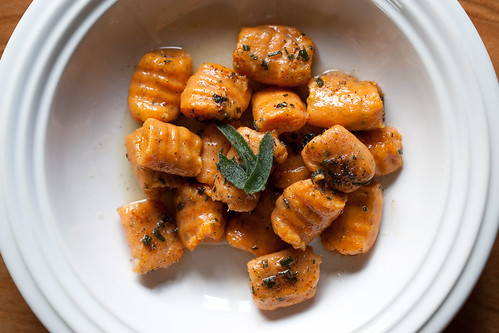
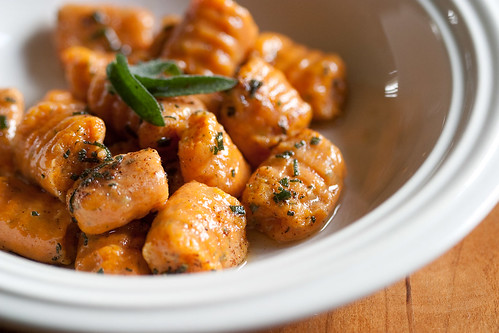
Sweet potato gnocchi with sage and brown butter

Somewhere in my past, I got off to a bad start with sweet potatoes. This is no great surprise: after all, I got off to a bad start with a lot of vegetables. But unlike with most other vegetables, I only overcame that bad start recently--as in, a few months ago rather than a few years ago.

And it's silly, isn't it? I don't know if I ever actually tried many sweet potato dishes before before digging in my heels about them. I don't even know what it was (is?) I didn't (don't?) like about them. I just had it in my head that they were... you know... ick.

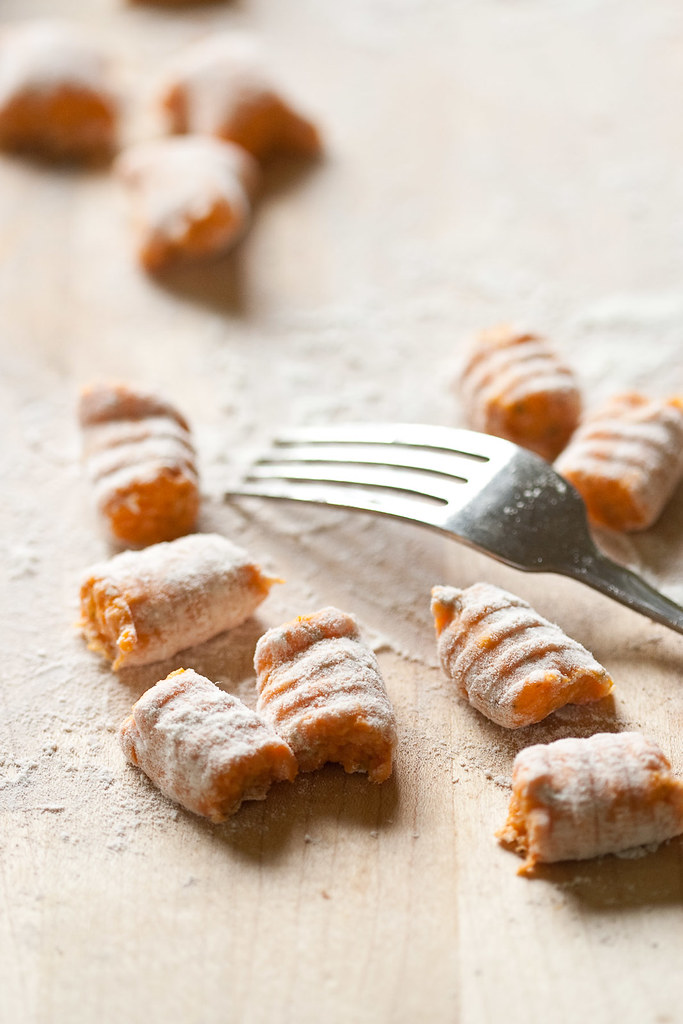
Gnocchi

Well, all that's changed, and I have Wendy to thank for it. The recipe that changed my mind, a sweet potato gnocchi with sage and brown butter, was Wendy's contribution to the inaugural round of the Cross Country Cooking Parade (CCCP) recipe exchange. In the CCCP we each submit one savory and one sweet recipe, we make all eight of the recipes, and we share with each other our thoughts on the recipes and the results.

One of the ideas behind the CCCP is that we'll be encouraged to cook foods that we might be hesitant to try, and I'm thrilled that I'm already benefitting from it. These gnocchi have not only revived my faith in my gnocchi-making abilities, they've sold me on sweet potatoes. Even if this is the only sweet potato dish I ever make, I'll be perfectly content, because I'm not sure how anything else involving sweet potatoes is going to top it. That's probably due at least in part to the fact that they involve a sage brown butter sauce, but really, they made a convert out of me even before I tossed them in the butter.

From the top

I suppose they fall under the "time consuming" label, but to be honest, they didn't feel like a lot of work. The sweet potatoes can be roasted a little while ahead of time, and roasting them is no trouble at all if you already have the oven on for, say, baking yourself a buttery, flaky croissant for breakfast. (Seriously, remind me to gush about those croissants in another post and make you all green with envy.)

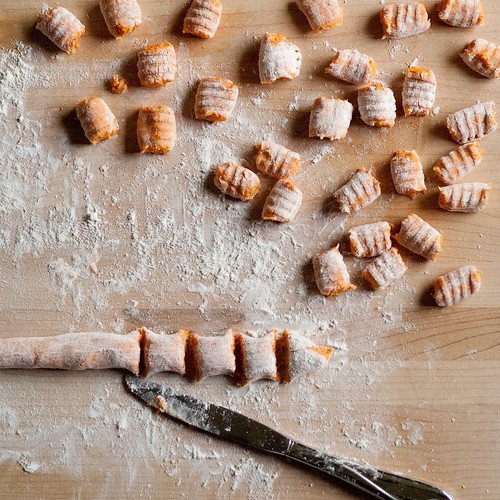
Once you're to the step of making up the dough, keep a light hand. The less you work the dough, the lighter and more pillowy the gnocchi will turn out, and the broader your smile will be when you finally sit down to eat them. (Or don't sit down, just eat them straight out of the pan in the middle of your kitchen. Who am I to judge?) In my experience--which, granted, has a sample size of only one--the dough is very soft and delicate, and sticky when bare, but not prone to absorbing additional flour. As a result, while you do need some extra flour while you're rolling and forming the gnocchi, you don't have to use a lot. One good dusting should be plenty.

Forming gnocchi

And speaking of plenty, a final note: the recipe calls for boiling the gnocchi for 10 seconds after they float to the top, and says that this should be about 5 minutes. Mine floated after 2 or 3, and, worried that they weren't done yet, I tried to let them cook the full 5 minutes. Big mistake--one that left me with a pot full of disintegrated gnocchi. If they float after 2 minutes, fine, that's plenty. Cook them for a further 10 seconds and get them out of the water. Then bathe them in brown butter and enjoy!

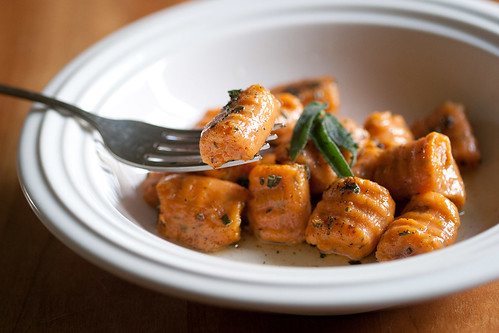
Bite

Sweet Potato Gnocchi with Sage and Brown Butter

Adapted from Marcella Hazan and The New York Times
Makes 6 servings

Ingredients

  • 1 1/2 pounds sweet potatoes
  • 1/2 cup all-purpose flour, sifted, plus up to 1/2 cup for kneading
  • 1/4 cup plus 2 tablespoons minced fresh sage
  • 1/2 teaspoon salt
  • 1 teaspoon freshly ground pepper
  • 1/2 teaspoon nutmeg
  • 1/4 cup grated Parmesan cheese, plus more for serving
  • 1/2 cup (1 stick) unsalted butter

Directions

  1. Preheat the oven to 350F/175C. Poke a few holes in each sweet potato to let steam escape, then place them on a baking sheet. Bake them until they're tender, about 45 minutes.
  2. When the potatoes are cool enough to handle, peel them and pass them through a ricer, or a food mill with a fine grate.
  3. Place the puree in a large bowl and add the flour, 2 tablespoons of the sage, the salt and pepper, and the cheese. Mix gently until just combined.
  4. Flour a work surface and scoop the dough out onto it. Dust the top and sides of the dough lightly with flour, and perhaps rub some flour between your hands so that they don't stick to the dough.
  5. Divide the dough into 6 equal pieces. Roll each piece under your palms so that it forms a long rope. [The original recipe says that the ropes should be about 1 inch wide and 20 inches long, but your mileage might vary.] Go ahead and sprinkle the dough with a bit of extra flour if it's sticking. Cut the rope into 1-inch segments, and roll each segment over the tines of a fork to form the characteristic indentations. (Use a gnocchi board if you're lucky enough to have one.) Collect the formed gnocchi on a baking sheet.
  6. When you've finished forming the gnocchi, bring a large pot of water to boiling and salt it generously. Drop several gnocchi into the boiling water (you'll need to work in batches so that you don't crowd the pot). Cook them for about 10 seconds after they rise to the surface. This could be only a couple of minutes, or up to five minutes. Use a slotted spoon to transfer the cooked gnocchi to a clean baking sheet, and cool completely.
  7. Place a large, heavy saucepan over medium-high heat and add the butter. Melt the butter and cook it, swirling occasionally, until the milk solids have turned a lovely chestnut color and smell nutty, about 5 minutes. If you plan to add fried sage leaves as a garnish, go ahead and fry them.
  8. Once the butter has browned, add the remaining chopped sage and turn off the heat. The mixture will bubble up, so don't be alarmed.
  9. Add the gnocchi to the sage butter, place over medium-high heat, and cook until the gnocchi are heated through, about 5-6 minutes. You might have to do this in batches, in which case it's useful to have the oven preheated to 300F/150C so that your earlier batches don't get cold. Divide the gnocchi and sauce among bowls, garnish with sage leaves (if desired), and serve.

Notes

  • Make-ahead: the gnocchi can be boiled up to 4 hours ahead, and kept at room temperature.
  • I haven't tried freezing these gnocchi, but based on this recipe I'm going to say go ahead and freeze them (prior to boiling) if you'd like to make them ahead of time and cook them later. Freeze them on a baking sheet, then transfer them to a zip-sealed plastic bag and freeze for up to 1 month. When you're ready to cook them, just dump them into the boiling water without thawing. They'll rise to the surface when they're done, just as with fresh gnocchi.
  • Wendy suggested, and I loved, a tart apple grated or cut into matchsticks and tossed with the gnocchi. I think it's a great variation.

There's more...