Showing posts with label Pastas. Show all posts
Monday, March 8, 2010

How I learned to love sweet potatoes

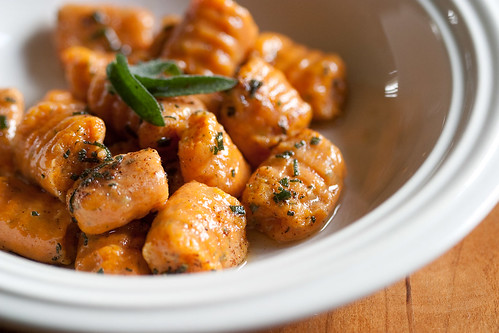
Sweet potato gnocchi with sage and brown butter

Somewhere in my past, I got off to a bad start with sweet potatoes. This is no great surprise: after all, I got off to a bad start with a lot of vegetables. But unlike with most other vegetables, I only overcame that bad start recently--as in, a few months ago rather than a few years ago.

And it's silly, isn't it? I don't know if I ever actually tried many sweet potato dishes before before digging in my heels about them. I don't even know what it was (is?) I didn't (don't?) like about them. I just had it in my head that they were... you know... ick.
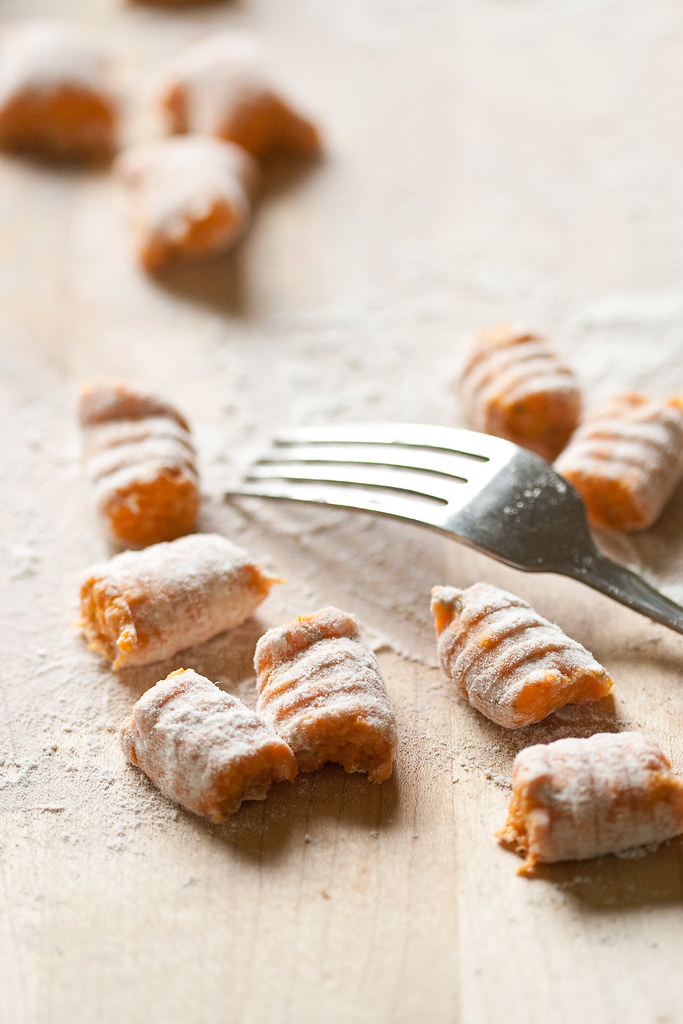
Gnocchi

Well, all that's changed, and I have Wendy to thank for it. The recipe that changed my mind, a sweet potato gnocchi with sage and brown butter, was Wendy's contribution to the inaugural round of the Cross Country Cooking Parade (CCCP) recipe exchange. In the CCCP we each submit one savory and one sweet recipe, we make all eight of the recipes, and we share with each other our thoughts on the recipes and the results.

One of the ideas behind the CCCP is that we'll be encouraged to cook foods that we might be hesitant to try, and I'm thrilled that I'm already benefitting from it. These gnocchi have not only revived my faith in my gnocchi-making abilities, they've sold me on sweet potatoes. Even if this is the only sweet potato dish I ever make, I'll be perfectly content, because I'm not sure how anything else involving sweet potatoes is going to top it. That's probably due at least in part to the fact that they involve a sage brown butter sauce, but really, they made a convert out of me even before I tossed them in the butter.
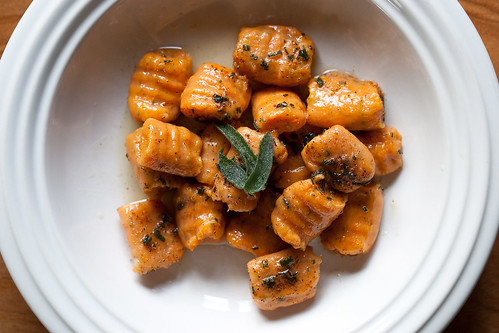
From the top

I suppose they fall under the "time consuming" label, but to be honest, they didn't feel like a lot of work. The sweet potatoes can be roasted a little while ahead of time, and roasting them is no trouble at all if you already have the oven on for, say, baking yourself a buttery, flaky croissant for breakfast. (Seriously, remind me to gush about those croissants in another post and make you all green with envy.)

Once you're to the step of making up the dough, keep a light hand. The less you work the dough, the lighter and more pillowy the gnocchi will turn out, and the broader your smile will be when you finally sit down to eat them. (Or don't sit down, just eat them straight out of the pan in the middle of your kitchen. Who am I to judge?) In my experience--which, granted, has a sample size of only one--the dough is very soft and delicate, and sticky when bare, but not prone to absorbing additional flour. As a result, while you do need some extra flour while you're rolling and forming the gnocchi, you don't have to use a lot. One good dusting should be plenty.
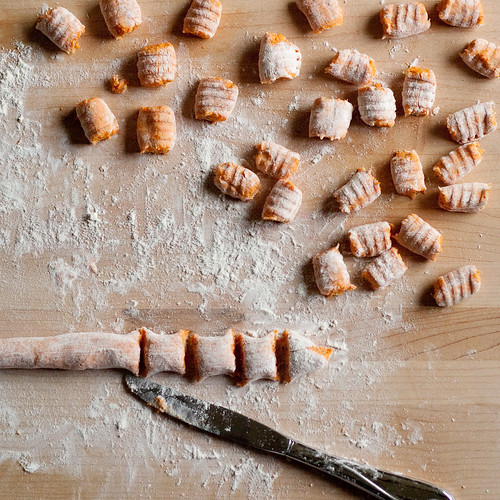
Forming gnocchi

And speaking of plenty, a final note: the recipe calls for boiling the gnocchi for 10 seconds after they float to the top, and says that this should be about 5 minutes. Mine floated after 2 or 3, and, worried that they weren't done yet, I tried to let them cook the full 5 minutes. Big mistake--one that left me with a pot full of disintegrated gnocchi. If they float after 2 minutes, fine, that's plenty. Cook them for a further 10 seconds and get them out of the water. Then bathe them in brown butter and enjoy!
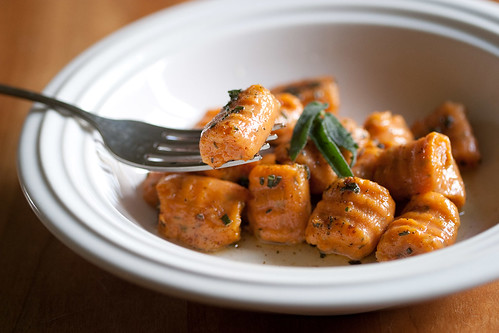
Bite

Sweet Potato Gnocchi with Sage and Brown Butter

Adapted from Marcella Hazan and The New York Times
Makes 6 servings

Ingredients

  • 1 1/2 pounds sweet potatoes
  • 1/2 cup all-purpose flour, sifted, plus up to 1/2 cup for kneading
  • 1/4 cup plus 2 tablespoons minced fresh sage
  • 1/2 teaspoon salt
  • 1 teaspoon freshly ground pepper
  • 1/2 teaspoon nutmeg
  • 1/4 cup grated Parmesan cheese, plus more for serving
  • 1/2 cup (1 stick) unsalted butter

Directions

  1. Preheat the oven to 350F/175C. Poke a few holes in each sweet potato to let steam escape, then place them on a baking sheet. Bake them until they're tender, about 45 minutes.
  2. When the potatoes are cool enough to handle, peel them and pass them through a ricer, or a food mill with a fine grate.
  3. Place the puree in a large bowl and add the flour, 2 tablespoons of the sage, the salt and pepper, and the cheese. Mix gently until just combined.
  4. Flour a work surface and scoop the dough out onto it. Dust the top and sides of the dough lightly with flour, and perhaps rub some flour between your hands so that they don't stick to the dough.
  5. Divide the dough into 6 equal pieces. Roll each piece under your palms so that it forms a long rope. [The original recipe says that the ropes should be about 1 inch wide and 20 inches long, but your mileage might vary.] Go ahead and sprinkle the dough with a bit of extra flour if it's sticking. Cut the rope into 1-inch segments, and roll each segment over the tines of a fork to form the characteristic indentations. (Use a gnocchi board if you're lucky enough to have one.) Collect the formed gnocchi on a baking sheet.
  6. When you've finished forming the gnocchi, bring a large pot of water to boiling and salt it generously. Drop several gnocchi into the boiling water (you'll need to work in batches so that you don't crowd the pot). Cook them for about 10 seconds after they rise to the surface. This could be only a couple of minutes, or up to five minutes. Use a slotted spoon to transfer the cooked gnocchi to a clean baking sheet, and cool completely.
  7. Place a large, heavy saucepan over medium-high heat and add the butter. Melt the butter and cook it, swirling occasionally, until the milk solids have turned a lovely chestnut color and smell nutty, about 5 minutes. If you plan to add fried sage leaves as a garnish, go ahead and fry them.
  8. Once the butter has browned, add the remaining chopped sage and turn off the heat. The mixture will bubble up, so don't be alarmed.
  9. Add the gnocchi to the sage butter, place over medium-high heat, and cook until the gnocchi are heated through, about 5-6 minutes. You might have to do this in batches, in which case it's useful to have the oven preheated to 300F/150C so that your earlier batches don't get cold. Divide the gnocchi and sauce among bowls, garnish with sage leaves (if desired), and serve.

Notes

  • Make-ahead: the gnocchi can be boiled up to 4 hours ahead, and kept at room temperature.
  • I haven't tried freezing these gnocchi, but based on this recipe I'm going to say go ahead and freeze them (prior to boiling) if you'd like to make them ahead of time and cook them later. Freeze them on a baking sheet, then transfer them to a zip-sealed plastic bag and freeze for up to 1 month. When you're ready to cook them, just dump them into the boiling water without thawing. They'll rise to the surface when they're done, just as with fresh gnocchi.
  • Wendy suggested, and I loved, a tart apple grated or cut into matchsticks and tossed with the gnocchi. I think it's a great variation.
There's more...

Wednesday, July 8, 2009

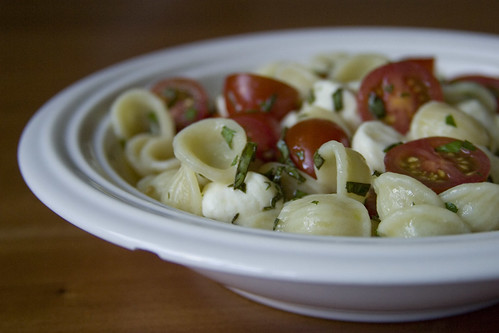
Orecchiette with Tomatoes and Mozzarella

Lunch

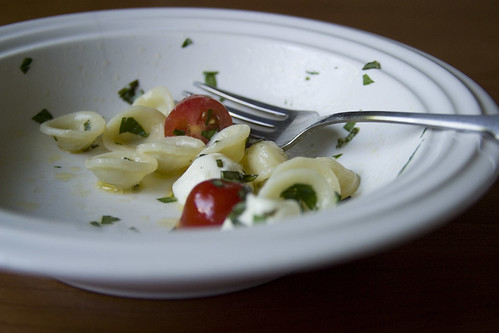
What you see in that picture there is my new favorite summer dish. It is a dish for those evenings when it's too hot to cook something really warm, but when, after weeks of hot weather, you're growing tired of eating only chilled or room-temperature foods. The pasta has a bit of warmth to it, which takes the chill off the cheese and makes it melt ever so slightly; it gives an illusion of warmth and heartiness without making you feel like you need to put a cool cloth to your forehead. At the same time, the tomatoes and herbs go in off the heat, so that what little cooking happens does so only with the leftover heat of the pasta. As a result, the flavors stay fresh and light in a way that's well suited to a summer afternoon or evening, but you also get just a hint of a rib-sticking feeling from the pasta and warm cheese.

This is also one of those dishes that's great for a weeknight, when you get home later than expected and just want to get something tasty on the table (and in your belly) without resorting to takeout. All of the prep can be done in the time between putting the water on to boil and taking it off to drain the pasta. The only dishes you'll dirty are a pot, a colander, a cutting board, and a knife, plus the bowl and fork you'll use to eat the pasta--you can even eliminate the bowl if you'd rather eat straight from the pot--so cleanup is quick.

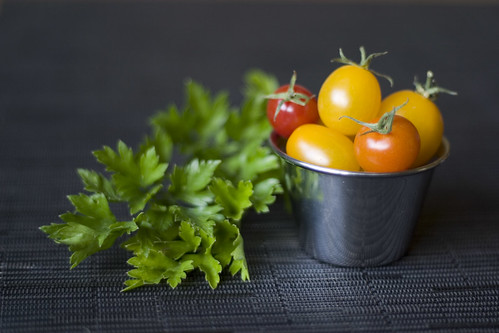
Parsley and tomatoes

What's more, it's easy. You boil some water and cook some pasta; you cut up some cheese and tomatoes; and you chop some herbs (you could even do the herbs in a food processor if you aren't all that confident with a chef's knife). And when the pasta's done, you essentially throw it all together in the same pot you used to cook the pasta, with a touch of olive oil and a squeeze of lemon juice or vinegar. There's little or no measuring required (I've provided measurements as a guide, but pretty much everything should be "to taste"), nothing to burn, and really very little you can do to screw it up, short of forgetting about the pasta for half an hour and letting it cook into mushy oblivion. Of all the recipes I've posted in recent memory, this is probably the easiest and most satisfying, and the one I'd most recommend to trepidatious newbie cooks.

And right now, as the first tiny tomatoes are starting to appear at the market, is a great time to make this recipe part of your collection. Cherry, pear, or grape tomatoes; one color or many colors; it doesn't matter: they all taste great in this dish. You could substitute pieces of a larger tomato, and I'm sure that it would be good, but I think that there's something about the flavor of cherry tomatoes that really works well here and is refreshingly different from standard pasta + fresh tomato fare. Use whatever herbs you have available, and/or whatever you think would taste good. I've had success with parsley + basil and parsley + mint, and the original recipe calls for oregano and garlic chives (or regular chives). My version is below the fold.

Orecchiette with Tomatoes and Mozzarella

Serves 4 generously

Ingredients

  • 10 ounces orecchiette pasta (roughly 3 cups uncooked)
  • 1 pound fresh mozzarella, either pea-sized perlini or cut to the size of fresh peas
  • 1 pound grape, cherry, or pear tomatoes, halved
  • 1/4 cup extra-virgin olive oil
  • 3 tablespoons fresh lemon juice or white vinegar
  • 1/4 cup minced fresh herbs (e.g. basil, parsley, oregano, chives...)

Directions

  1. Bring a large pot of water to a boil, and salt it generously. Cook the pasta until it is tender but firm, stirring now and then to ensure that the pasta does not stick together.
  2. Drain the pasta and return it to the pot.
  3. Add the mozzarella to the hot pasta. Stir until the cheese softens and starts to melt, about 30 seconds.
  4. Add all remaining ingredients, and toss gently to distribute herbs evenly. Season to taste with salt and pepper, and serve.

Lunch: almost gone

There's more...

Sunday, March 23, 2008

Linguine with Leeks, Radicchio, and Walnut Pesto

Katie and I made this yesterday evening for dinner, using radicchio from my CSA box and parsley and lemon from the garden. It was easy, relatively quick, and delicious (though it did need a fair bit of seasoning, particularly with salt). It would also stand up well, I think, to additions and substitutions: garlic, crushed red pepper, pancetta if you're so inclined, lemon zest in the pesto, and so on. Katie was tasked with making the pesto, and she was rather heavy-handed with the cheese and walnuts, so this version will differ a bit from what's written up at the link.

Linguine with Leeks, Radicchio, and Walnut Pesto
Serves 2-3, or more as a side dish

8 ounces linguine or other noodly pasta
5 tablespoons extra-virgin olive oil, divided
3 cups thinly sliced leeks, white and light green parts only
1/2 cup (packed) fresh Italian parsley leaves
1/2 cup grated Parmigiano Reggiano, plus more for serving
1/3-1/2 cup walnut pieces (1.5-2 ounces)
2 teaspoons fresh lemon juice
2 cups thinly sliced radicchio
Salt and freshly ground pepper

Cook pasta in a large pot of boiling, salted water until al dente. Drain pasta, reserving 1 cup cooking liquid.

Meanwhile, heat 2 tablespoons oil in a large skillet or pot (one with a lid) over medium-high heat. Add leeks and season generously with salt and pepper. Cover and cook until leeks are tender and beginning to brown, stirring occasionally, about 10 minutes.

While the leeks cook, puree parsley, cheese, walnuts, lemon juice, and 3 tablespoons oil in food processor until coarse paste forms. Season pesto with salt and pepper. Add pasta, pesto, and radicchio to leeks and toss to combine, adding cooking liquid by tablespoonfuls if dry. Garnish with extra Parmigiano and serve.

There's more...

Sunday, October 21, 2007

Skillet Chicken with Broccoli, Whole Wheat Penne, and Parmesan

This is another one that I modified so much it's almost a different recipe. The basic technique is the same, though, so I'll credit America's Test Kitchen's Skillet Chicken with Broccoli, Ziti, and Asiago Cheese (free subscription required) for the inspiration. Basically I just made it with what I had on hand, substituting and/or omitting ingredients as necessary.

Skillet Chicken with Broccoli, Whole Wheat Penne, and Parmesan
Serves one generously, or two modestly.

One small boneless, skinless chicken breast, cut into 1" squares 1/4" thick.
Olive or vegetable oil
1/3 cup minced shallot
1 clove garlic, minced
generous pinch of dried oregano
pinch of red pepper flakes
2 ounces whole wheat penne, uncooked
1 1/4 cups chicken broth
1/4 cup water, plus more if needed
1 cup broccoli florets
2 T milk
1/3 cup grated Parmigiano Reggiano
fresh lemon juice
Salt and freshly ground black pepper

Sprinkle the chicken with salt and pepper. Heat about a tablespoon of oil in a small skillet (my 6" worked just fine) over medium-high heat until nearly smoking. Add the chicken, spread out in skillet, and let cook one minute before stirring. Cook until the chicken is lightly browned and most (not all) of the pink color has disappeared, 2-3 minutes in total. Transfer chicken to a clean bowl and set aside.

Put another tablespoon or so of oil in the pan, let heat, and add the onion to the skillet. Cook, stirring often, 2-5 minutes, or until the onion is softened. Stir in the garlic, oregano, and red pepper flakes, and cook another 30 seconds, or until fragrant.

Add the uncooked pasta and the chicken broth, and bring to a boil. Let simmer, stirring frequently to ensure that the pasta cooks evenly, 12-15 minutes, or until the liquid is syrupy and almost entirely absorbed. Add the broccoli and water to the pan. Cover, reduce heat to medium-low, and cook 3-5 minutes, until the broccoli is bright green and almost tender.

Uncover and turn the heat back to high. Stir in the milk, cheese, and reserved chicken with any accumulated juices. Continue to cook, uncovered, 1-2 minutes, or until the sauce is thickened and the chicken is cooked through. Remove from heat, add a squeeze of lemon juice, and season to taste with salt and pepper. Serve with additional cheese for sprinkling and if you like, some crusty bread for mopping up the sauce (I highly recommend this).

There's more...

Saturday, February 17, 2007

Linguine with spinach and prosciutto

I love spinach, but I must admit that I can only eat so many salads before I start looking for another way to get my leafy greens. Enter inspiration in the form of this recipe. I made a substantial number of changes to the recipe, though, so I'm going to write it out the way I made it. (The prosciutto is easily omitted if you prefer a vegetarian version.)

Linguine with spinach and prosciutto
(Serves two as a substantial side dish, or one as a main dish with leftovers)

4 ounces dried whole wheat linguine
4 ounces fresh spinach
thinly sliced prosciutto, cut into 1/2-inch pieces (I used three medium-sized slices)
3 medium cloves of garlic, minced
1 tablespoon dried basil
1 teaspoon chopped fresh oregano leaves
1 teaspoon crushed red pepper
olive oil and/or EVOO as needed (say 3 tablespoons)
Parmigiano Reggiano as desired

Combine prepared prosciutto, garlic, basil, oregano, and crushed red pepper in a bowl.

Bring a large pot water to a boil, salt, and add pasta.

While the pasta cooks, heat a tablespoon or two of olive oil in a small skillet and cook prosciutto/garlic/herb mixture over medium-high heat for a few minutes, stirring frequently so that the garlic doesn't burn. Cook until deliciously fragrant and the prosciutto (if using) begins to crisp. Also chop half of the spinach leaves into thin strips, reserving whole leaves.

When the pasta is done, drain and return to pot. Toss with the cut spinach, prosciutto/garlic/herb mixture, freshly grated Parmigiano Reggiano, and a tablespoon or so of EVOO (if needed). The spinach should wilt a bit with the heat of the pasta. If you're using the prosciutto, that will probably provide plenty of saltiness; if not, you may need to season the pasta with some salt.

To serve, place reserved spinach leaves on plate(s) and mound pasta on top of spinach. Top with a bit more cheese, if you like, and devour.

There's more...

Monday, May 16, 2005

Pasta Riace

This spaghetti (or linguine) recipe is one of my favorites, and a great thing to cook when you're hungry and it's getting late and you just want something to eat. It's great by itself, but sometimes I throw some chicken or a pork chop (usually dressed in nothing but olive oil, sea salt, and freshly ground pepper) on my cast iron grill pan to add some protein to the mix. It doesn't add much to the overall cooking time of the meal. I first had this, or something very much like it, at Cafe Riace (reviewed here) in Palo Alto, and was determined to reproduce it in my own kitchen. After a few trials, including a few cloves of overdone garlic, I think I've pretty much got it down pat, at least to the point where I like it well enough to call it "done." I mentioned it recently on a post over at my other blog (here), but here it is in a more organized format. The recipe looks long, but that's just because I ramble. It's actually one of the quickest and easiest things I've ever made for dinner, and the ingredients are ones I always have in the pantry--and if you don't have one or two or three of the ingredients, no worries, it's a wonderfully versatile recipe.

You will need:

Butter and/or extra-virgin olive oil
Garlic: a few cloves, depending on how many people you're feeding and what their garlic tolerance is--I usually use 2-3 medium-sized cloves for myself
Crushed red pepper
Parsley (flat-leaf, of course)
Salt, preferably sea salt
Freshly ground pepper (optional)
Parmigiano Reggiano
Long, thin pasta--either spaghetti or linguine--enough to feed your crowd

Get a pot and fill it with enough water for however much pasta you're planning on cooking--as always, give it plenty of room to move around as it's cooking. (Semi-apologetic note: I realize that most people reading this blog know perfectly well how to cook pasta properly, thank you very much, but you'd be surprised at some of the heresy I've seen when it comes to cooking pasta. Better safe than sorry.) Set it over high heat and leave it alone for a wee while.

While that's coming to a boil, do your garlic and parsley. Peel the garlic cloves, and either mince them or put them through a garlic press--I do the latter because it's easier, it gets more of the juices out, and the texture of the crushed garlic works better. Put the garlic aside. Rinse and finely chop a small handful of parsley, then put that aside as well.

When the water is boiling, salt it generously and add your noodles. Get out a small skillet (I use my 6" one) and put it over medium-low heat. Add some butter and/or olive oil (I find the flavor is a bit richer with butter, and I put in a bit of olive oil to help protect the butter a bit). For me, I use maybe a tablespoon of butter and as much again of olive oil, but the amounts you use will depend (as always) on how many people you're serving and how much garlic you'll have going. You can always add more butter or oil later, so best to err on the side of caution--you don't want the garlic to be swimming in oil, but you don't want there to be so little that it burns, either. Anyway, get the butter melted and the oil sleek and shimmery, but NOT too hot--you don't want to have it so hot that your garlic fries and becomes bitter.

Tip in your garlic and shake in some crushed red pepper (about 1 - 1.5 teaspoons per person) and let that infuse slowly and gently. Keep your heat as low as you can get it without it shutting off on you. The key here is to let the garlic soften and lose some of its hit-you-over-the-head sharpness, while infusing the richer garlic flavor into the butter/oil. The crushed red pepper infuses nicely, too. You can add the parsley at any time, really: sometimes I add it right away, and other times I add it right before the spaghetti finish cooking. It doesn't seem to matter. Either way, keep an eye on your garlic skillet, and do not let it reach anything other than a slow bubble, if even that.

When the pasta is cooked to your liking ("done" for me means that when bitten, the pasta no longer has a white core), drain it well, dump it in a big bowl, and grate some cheese over it. Mix it up, grate some more cheese, etc. until all the noodles have at least a bit of cheese on them. Then add the butter/oil-garlic-pepper-parsley "sauce," draining out some of the oil if need be, and then add some salt and toss it so that it's well mixed. I usually grate more cheese over it and mix that in, but the amount of cheese you add is up to you. I eat it straight from the bowl, but if you're serving multiple people, you might want to put it in individual bowls or on plates. :)

There's more...